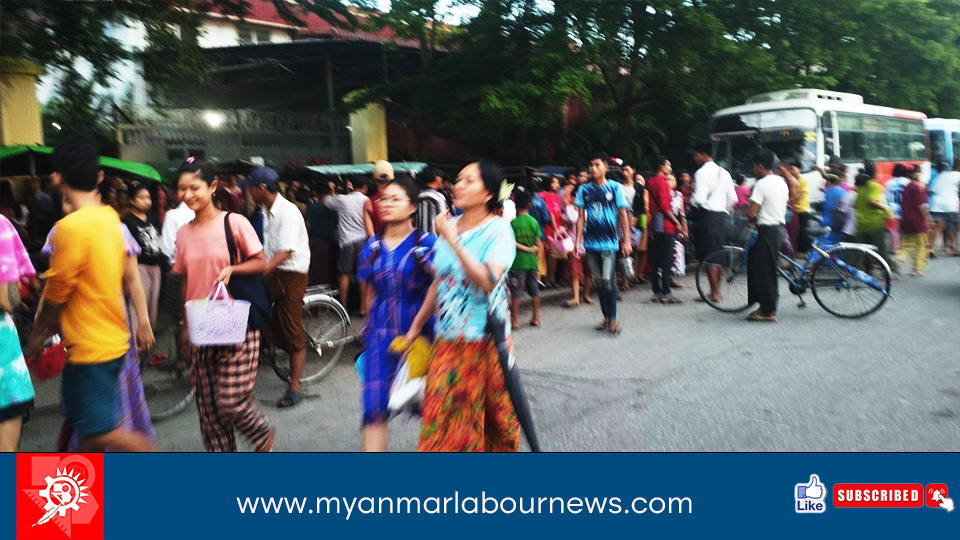

Workers working in workspace where there is no dignity (or) 2024 June violations
Workers told Myanmar Labor News that many workers in garment factories in Yangon fell ill and were not in good health due to the rains on many days last June. In spite of this illness, it was found in the June analysis that the factories force the workers a lot of overtime.
Calling for overtime, verbally abusing and cutting financial benefits as found in last May's analysis, have been happening continuously this month as well. Verbal abuse incidents were found to be half of the overtime violation process that occurred the most.
Myanmar Labor News has only written annual reviews in recent years. When writing reviews, we noticed an increase in the number of infringing factories, therefore we write reviews every month to find justice for the violations.
There were 26 factories reported for labor right violations in June. Among these factories, there are up to 10 factories reported for verbal abuse. The May review found 12 factories with workplace verbal abuse. Therefore, it can be considered that there is no decrease.
It is written on the National Unity Government, Ministry of Health's social network website that verbal abuse belongs to the category of workplace bullying, and the victims may experience less focused on work, get headache, anxiety, easily depressed, easily tearing, can’t sleep regularly at night, insomniac, insecure, lack of confidence and a decrease in ability to work.
In June, the Myanmar Labor News website published 122 news stories. Among them, 26 factories were found to have violated workers' rights. In addition to 29 reports of violations, foreign migrant workers' news, article on international labor movements, Interviews and politics and business news are also reported.
LABOR RIGHT VIOLATING FACTORIES
According to the table, the reported factories are 19 garment factories, backpack factory, bag factory, shoe factory, plush doll factory, soft drink factory, printing and manufacturing facilities. It has also been found that there are at least 100 to more than thousands of workers in those factories.
Most Violating Sectors and Factories
The most frequent violation in reviewing the news reported in June is overtime calls. According to the data, 20 of the 26 factories forced them to work overtime and violated their rights.
There are 13 factories that doesn’t provide wide workplace, purified water, heat adjustment, medic-clinic and transportation. There are 13 factories that cut the workers benefits for absents, 12 factories which force the workers by pressurizing, 11 factories that doesn’t grant leaves and 10 factories that verbally abuse the workers.
Asking impossible fabric outputs and forcing the workers to work continuously more than 5 hours without giving break is happening in 6 different factories.
There are 6 factories that discriminate the workers who take leaves, can’t finish the outputs and doesn’t work overtime. 4 factories are reported for not officially hire the day laborers.
There was 4 follow-up news reported about a pay-raise demand in a factory. 3 factories are reported for illegal dismissals and 2 factories are reported for allowing foreigners to manage the workplace directly. There are 2 factories which force the workers to lie the brand representatives and officials from the labor office. There are 1 factory each reported for assigning the child labors with adult’s tasks, not taking responsibility for workplace accident, dismissing pregnant workers, violating social security law, failed to sign EC contract and not giving full break time.
Myanmar Labor News has classified 27 types of violations and found 21 types of labor rights violations in June.
During June, the He MeT Company Limited garment factory, which manufactures ever.me, Page One, and MO (WOMAN) brands, was found to be the most violating factory.
The factory is verbally abusing, not allowing leave, dismissing, forcing overtime, discriminating, hiring child laborers, not officially hiring day laborers, cutting the benefits, asking for excessive fabric outputs, having workplace requirements, forcing the workers to lie and dismissing the pregnant
There are more than 1,000 He MeT garment factory workers and one of the workers said that
“A cavity with 45 people including the super is asked for 40 fabric per hour. The supervisors are rude as well. The super of line 4 and 6 is a man and he is verbally abusing the female excessively.”
Workers said that the factory is owned by a Chinese national and manufacturing ever.me, page one and MO WOMAN brand fabrics with more than 1,000 workers.
HUAFU Garment factory from Mya Sein Yaung Industrial Zone doesn’t hire the day laborers as permanent stuffs and workers are working without dignity due to being verbally abused.
“Day laborers are not entitled to paid Sunday day off. They can’t contribute to social security so they don’t get free health care from the social security clinics. Its sad to see the child laborers are assigned the same tasks with the adults,” said a worker.
Workers said that they are asked for excessive fabric outputs and being verbally abused by the supervisors and the manager so that they feel that they are working without dignity.
The factory is manufacturing PORT AUTHORITY brand jackets and it is owned by a Chinese national. There are around 1,200 workers in the factory and they are being humiliated every day.
“We are working for our livelihoods but they don’t satisfy no matter how much we worked for them. Its like we are going to the factory to be humiliated. The working hours are from 8:00 am to 8:00 pm. We got transportation in the night but there are inspections by the soldiers and arrests as well. Sometimes we have to work all night overtime due to important fabrics. Workers have to work all night overtime on Saturdays without being informed in advanced and those who aren’t are held grudges against,” said a worker.
A factory reported with 8 violations is LITA MYANMAR garment from Shwe Pyi Thar Industrial Zone 4. The factory calls mid-night and all night overtimes on public holidays, pressurize and discriminate the workers who don’t want to work overtime, bias the expert and annual fees, increasing the fabric output demands, not allowing leave, cutting the daily wages, foreigners managing directly the workplace and violating the photographing ethics and threatens the workers with police and military.
Myanmar Labor News reported that there were violations after the recruitment of Myanmar garment workers by factories in China. There have been complaints in the past months and Ying Jiang. ShiShang Co.ltd factory from No (2), Ying Jiang New City Industrial Zone, Yunnan was reported in June.
The violations are forcing the workers more than 8 hours a day, exploiting, verbally abusing, intimidating, not providing enough food and cutting the daily wages.
The rest of the factories were found to have five or fewer violations.
Findings
In addition to the most occurred cases, forcing overtime in June, discrimination for not working overtime also occurred. As a follow-up, entitlements and financial cuts are not decrease. Child labor is on the rise and the rights of day laborers are still being violated. It was also stated in the news that the workers suffered due to the exploitation of the bonus by a supervisor.
We also found violations of social security law, failed to provide employment contract and dismissing the pregnant workers.
Although the law stipulates a working time range of 5 hours, it is obvious that the workers who currently work overtime work from at least 6 hours to a maximum of 8 hours. It is also found that the number of consecutive working hours has been high for two months in a row.
The rude behavior of foreigners and direct managements have occurred again in the factories.
Review
Starting at the end of April, overtime hours are increasing at garment factories. In the beginning, , there were not many factories that force to work more than 20 hours a week which is limited according to the Ministry of Labor's directive on overtime, but in May and June, violations of the law increased.
Some factories force overtime until 4:00 am which is known as “All Linn” and some factories forced until 00:00 am which is known as “All Night” overtime. Those overtime become more common in June and workers’ health are affected which even leads them to be dismissed.
Young workers are entering the garment industry, including many underage workers.
Factories force overtime, discriminate, cut the benefits and force overtime for free on the grounds of not finishing the output demands as follow-up.
It is also seen that the services provided by the factory to the workers continue to decline. Factories failed to provide transportation, purified water, medic-clinic and medicine, heat adjustment, fixed working hours, meals and medicine for overtime and comfortable sleeping place after calling all night overtime.
All workers who are not allowed to go home after working overtime until late night will not get the full 8 hours of rest required for a person. A worker who work overtime until mid-night have to get back up at 5 in the morning. They have to prepare for the next working day which starts at 7:00 am without proper rest and this type of violations happens often if not daily.
In June, health problems among workers became common. Workers are facing rising home medicine prices and even overtime pay is relatively high, but it still falls short of commodity prices.
Workers need to have good health conditions for high long-term income. We would like to inform that the long-term health effects on the workers have already started due to the current excessive fabric output demand and overtime forcing.
, For the members of the federation, , wages, The workers' mental health, Myanmar Labor News encourages labor activists, unions, federations, members and the authorities to take care of the workers mental and physical health as how they help upon their wages and damages.
Min Ni Kyaw
Myanmar Labour Society
Research Team